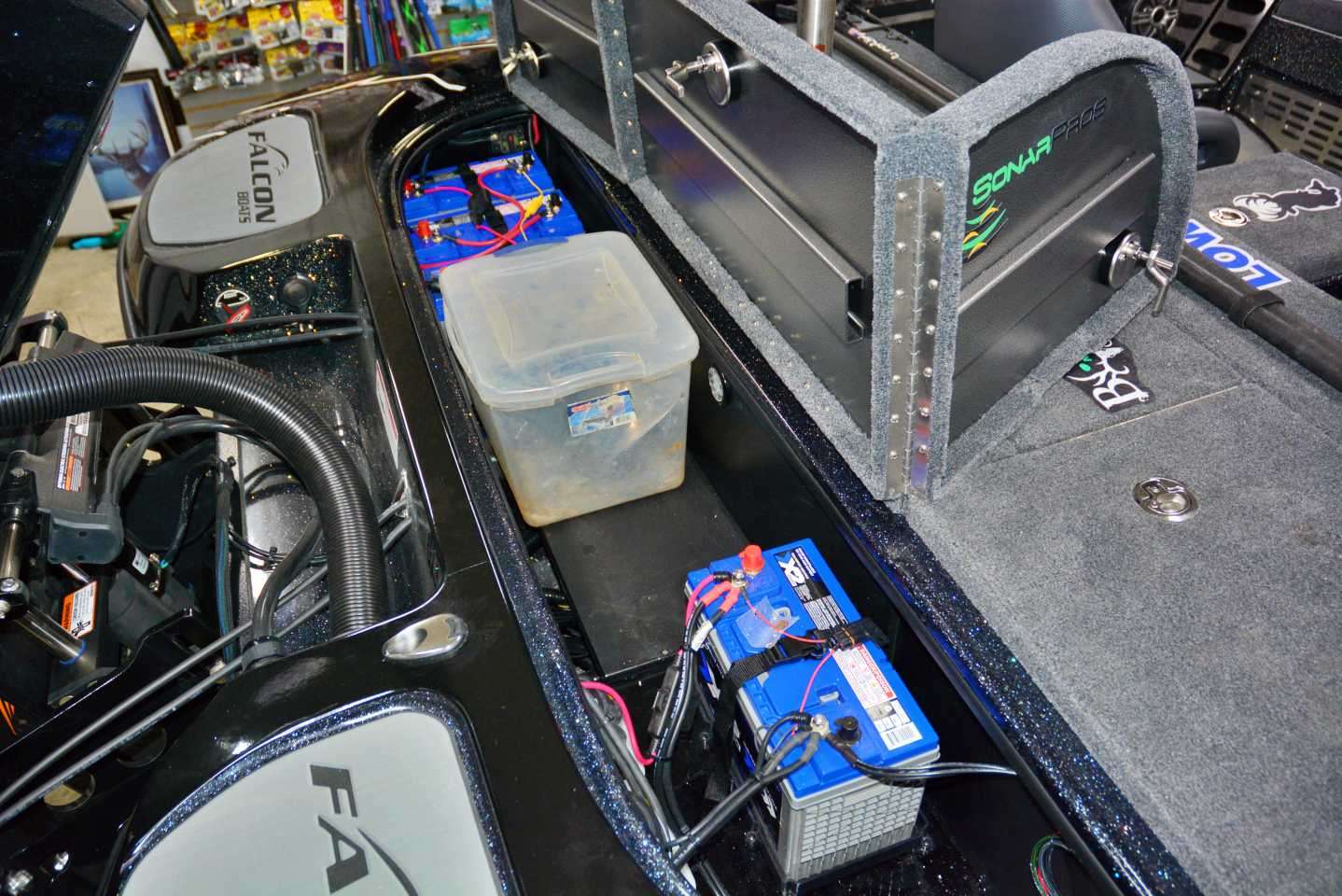
Spoiler alert: Your sonar doesn't care if it's getting 12 volts or 16 volts. Here's why.
If you've been shopping for lithium batteries lately—or watching YouTube videos from anglers sponsored by lithium companies—you've probably heard claims like "16 volt gives you better sonar imagery" or "more voltage equals more transmit power" or my personal favorite, "I can see fish I couldn't see before after switching to 16V."
No. Higher voltage does not improve your sonar image quality. At all.
I'm not saying this as someone who doesn't run lithium—I run three LiFePO4 batteries on my trolling motor and a dedicated 100Ah lithium just for electronics. I'm saying this as someone who actually understands how these electronics work from an engineering perspective.
The claims about 16V improving sonar performance are mostly marketing, not science. But here's the thing: lithium batteries and dedicated wiring ARE worth considering for legitimate reasons. The problem is that the actual benefits get buried under myths that don't hold up to basic electrical engineering scrutiny.
Let's break this down three ways: the quick answer for when you're at the ramp and some guy is telling you his LiveScope "pops" more on 16 volts, the real explanation for what's actually happening inside your fish finder, and the hardcore science with manufacturer specs and technical documentation for everyone who needs proof.
Section 1: The Quick Answer (For When You're At The Ramp)
Question: Will 16 volt power give me better sonar images than 12 volt?
Answer: No. Your sonar will produce identical images on 12V or 16V.
Here's the deal in plain English: Your Lowrance, Garmin, or Humminbird doesn't care whether you feed it 12 volts or 16 volts. Inside every one of these units is a sophisticated power regulation system that converts whatever voltage you provide (within the manufacturer's specified range) down to the exact internal voltages the electronics need.
Your display? It runs on regulated 5V internally—whether your battery is at 12V or 16V.
Your processor? It runs on 1.2-3.3V internally—whether your battery is at 12V or 16V.
Your transducer driver circuit? It generates its own 100-300V pulses using internal transformers and capacitors—completely independent of your battery voltage.
The voltage you feed the unit is just raw material. The unit takes what it needs and regulates everything internally. Feeding it 16V instead of 12V is like overfilling your truck's gas tank expecting it to drive faster—the engine only burns what it needs, and the extra just sits there doing nothing.
That said, an overfilled tank can compensate for a leaky fuel line. If you're losing fuel along the way, starting with more means you still arrive with enough. That's the one semi-legitimate argument for 16V: it can mask voltage drop from undersized wires, long runs, or corroded connections. If you start with 16V and lose 2V across bad wiring, you still arrive at 14V—plenty for your electronics. Start with 12V and lose that same 2V, and you're at 10V—below spec and causing problems.
But here's the thing: the real fix is to repair the fuel line, not keep overfilling the tank. Run proper gauge wire, clean your connections, and a 12V system works perfectly. Using 16V to overcome bad wiring is an expensive bandage.
But Wait, My Sonar Really Does Look Better After Switching to 16V Lithium!
I believe you. But here's what likely happened:
You isolated your electronics from your pumps and other accessories. Most anglers run electronics off their starting battery—the same battery powering livewells, bilge pumps, aerators, and navigation lights. All of those motors and pumps generate electrical noise. When you switched to a dedicated 16V lithium just for electronics, you eliminated that shared circuit—likely installing a dedicated wiring harness to your electronics in the process. If you previously ran off the trolling motor bank (less common, but some do), you also eliminated the MASSIVE noise from the trolling motor —interference spanning 8 kHz to over 100 MHz that directly overlaps with your Side Imaging and MEGA Imaging frequencies. Either way, THAT'S what was degrading your image. The isolation fixed it, not the voltage.
You eliminated voltage sag. If you were running AGM or lead-acid batteries that sagged to 10.5V under load, your electronics were operating at the ragged edge of their minimum spec. Now they have stable power. Again—it's the stability, not the 16V specifically, that helped.
You upgraded your entire electrical system. New battery, new wiring, new connections. Old corroded connections and undersized wiring cause voltage drops and noise. You fixed those problems during installation—you repaired the "fuel line," and that's what made the difference.
Placebo effect. You spent $400+ on a battery. Your brain wants to see improvement. This is human nature, not an insult.
The Bottom Line for Section 1
If someone at the ramp tells you their LiveScope is sharper because of 16V, they're experiencing one of the effects above—not a magical voltage improvement. Your sonar's display quality is determined by internal circuits running on internally-regulated voltages that have nothing to do with whether your battery says 12V or 16V on the label.
Want to understand WHY this is true? Keep reading. Want peer-reviewed proof and manufacturer specs? Skip to Section 3.
Section 2: The Real Explanation (Why Voltage Doesn't Matter—But Clean Power Does)
Let's get into how your fish finder actually works. This isn't boring theory—this is the stuff that will help you troubleshoot real problems and avoid wasting money on solutions that don't address the actual issue.
How Your Fish Finder Regulates Power
Every modern marine electronics unit uses switch-mode power supplies (SMPS) to convert incoming battery voltage to stable internal voltages. This is the same technology in your laptop charger, phone charger, and basically every modern electronic device.
Here's what happens when you connect power:
- Battery voltage enters the unit (could be 10V, 12V, 16V, 24V—whatever's within spec)
- SMPS circuits "chop" and regulate this input to fixed internal rails:
- 1.2-3.3V for the main processor/DSP
- 3.3V for memory and I/O
- 5V for the display controller
- These internal voltages are CONSTANT regardless of input voltage
The Physics: Your fish finder is a constant-power load. It draws a specific wattage regardless of input voltage. Because Power = Voltage × Current (P=V×I), when you increase the input voltage, the current draw actually decreases to maintain the same wattage. A unit drawing 24W at 12V (2 amps) will draw only 1.5 amps at 16V—same power consumption, same internal operation, same sonar performance.
The key insight: Your processor doesn't know or care what voltage your battery is. It sees the same 1.2V it was designed for, every single time.
How Transducer Transmit Power Actually Works
This is where the "more voltage = more transmit power" myth completely falls apart.
Your sonar's transmit power—measured in watts RMS—is NOT determined by your battery voltage. Your fish finder takes the regulated internal DC voltage and uses a step-up transformer to generate the 100-300V+ pulses needed to drive the transducer. The transmit power is determined by the transformer design, the capacitor size, and the MOSFET driver circuit—all fixed components designed during manufacturing.
Whether your battery provides 12V or 16V, the internal bus voltage is regulated, and the transformer output is designed to deliver a specific transmit power. Your 500W RMS unit delivers 500W RMS whether you're on a cheap flooded lead marine battery or a $600 lithium system.
Manufacturer Voltage Specifications
Lowrance:
- HDS Live/Pro: 10.8-17V — Same performance across range
- ActiveTarget: 10.8-31.2V — Wide range for 12V/24V systems
Garmin:
- ECHOMAP Ultra: 9-18V — Same performance across range
- LiveScope GLS 10: 10-32V — Accommodates 24V systems
Humminbird:
- Helix: 10-20V — Same performance across range
- MEGA Live: 10-20V — Same performance across range
- MEGA 360: 10-20V — Same performance across range
Notice anything? No manufacturer claims improved performance at higher voltage. They specify a range, and the unit performs identically anywhere within that range. The wide ranges on live sonar modules (up to 32V) exist to accommodate 24V boat systems, not because more voltage helps.
What ACTUALLY Affects Your Sonar Image Quality
Now let's talk about what genuinely matters—because if you're chasing better sonar performance, you should focus here instead of battery voltage.
1. Transducer Installation (The Factor That Actually Matters Most)
Here's the truth nobody selling batteries wants you to hear: transducer installation has more impact on sonar performance than every other factor on this list combined. You could have the cleanest power system in the world, and a poorly installed transducer will still give you garbage images.
Mounting Location:
- Transom mount: Must be positioned where water flows smoothly off the hull—typically 3-6" from the engine's lower unit and not inline with strakes.
- Trolling motor mount: Forward-facing sonar typically mounts here and the angle of the transducer matters dependent, follow your manufactures specs.
- Shoot-through-hull: Works only on solid fiberglass (no wood core, no foam). Reduces signal strength 10-20%. This is great for higher speed 2D sonar.
Level and Angle: Your transducer face must be parallel to the water surface at running speed—not at rest. For Side Imaging and MEGA Imaging, even 2-3° off level creates asymmetric images—one side looks great, the other looks washed out. There are tips and tricks online.
Water Flow and Turbulence: Your transducer needs laminar (smooth) water flow across its face. Turbulent water creates air bubbles that block acoustic signals, cavitation noise that overwhelms returns, and intermittent signal dropout at speed. If your sonar works great at idle but falls apart above 15 mph, you have a turbulence problem—not a power problem.
The Bottom Line: I've heard of anglers spending $800 on a 16V lithium battery when their transducer was mounted crooked, too high, and in turbulent water behind a strake. They'd have gotten 10x better results from a $20 transducer bracket adjustment and 30 minutes with a level.
2. Electrical Isolation (This Is The Big One For Power)
The single biggest electrical improvement most anglers can make is isolating electronics power from shared circuits.
Most bass boats run electronics off the starting battery—the same battery powering livewells, bilge pumps, aerators, and navigation lights. Every one of those motors and pumps generates electrical noise when cycling on and off. Livewell pumps can create voltage spikes and EMI.
When you install a dedicated electronics battery—whether it's 12V or 16V—you break that conduction path. This is "conducted" noise, and electrical isolation is the only true physics-based cure.
This is why people experience genuine improvement after switching to dedicated lithium electronics batteries. It's the isolation, not the voltage.
3. Voltage Stability (Not Voltage Level)
Here's a legitimate advantage of lithium over lead-acid, but it's about stability, not the number on the label.
LiFePO4 maintains nearly flat voltage across 80%+ of its discharge (staying within ~0.5V from 100% to 20% State Of Charge). Lead-acid drops approximately 1.2V across the same range. When your lead-acid battery sags to 10.8V under load—right at the minimum spec for most fish finders—you might experience issues or reboots.
A 16V lithium system provides additional headroom above these minimums—but a 12V lithium provides the same flat discharge curve. You're paying extra for headroom (overfilling your gas tank) you likely don't need if your electronics are on a dedicated battery.
4. EMI Suppression (Ferrite Cores)
Ferrite cores act as passive low-pass filters that block high-frequency interference. Install them on power cables (as close to the fish finder as possible), transducer cables, and Ethernet/NMEA cables.
What to buy: Type 31 ferrite material is optimal for marine electronics, covering 1-300 MHz—significantly better for the 1 MHz+ frequencies used by MEGA Imaging, LiveScope, and Side Imaging than the more common Type 43. Pick the right diameter and you can pick these up at Amazon - https://amzn.to/3ZKZslK
5. Proper Grounding and Cable Routing
Star ground configuration (all grounds to a single point) eliminates ground loops. Keep signal cables separated from high-current wiring. These basics cost nothing and prevent interference.
Why The 16V Myth Persists
Marketing drives it. Lithium battery companies need to differentiate premium products. "Better sonar" is an easy claim that's hard to disprove without engineering knowledge.
Correlation gets mistaken for causation. Angler upgrades to 16V lithium, installs it properly with new wiring, isolates from shared circuits, adds ferrite cores during install, gets better images. Assumes voltage was the variable. It wasn't.
Confirmation bias. After spending $400-800 on a battery, your brain wants to justify the purchase.
It sounds logical. "More power must be better" is intuitive even when it's wrong.
Nobody's testing it properly. To actually test this, you'd need the same unit, same transducer, same water conditions, powered by 12V vs 16V with identical isolation and wiring quality. Nobody does this because it's boring and proves the null hypothesis.
Section 3: The Science (Technical Documentation and References)
For those who want the engineering receipts, here's the technical foundation.
Internal Voltage Regulation
A published teardown of a Humminbird FishFinder 535 by EE Times revealed the internal architecture common to marine electronics: a Samsung ARM processor operating on 1.2V core/3.3V I/O (internally regulated), with SMPS ICs converting 12V input to multiple regulated rails. The 12V input serves as raw power that is converted regardless of its specific voltage within operating range.
Reference: EE Times, "Under the Hood Teardown: Humminbird FishFinder" - https://www.eetimes.com/document.asp?doc_id=1281283
Transducer Driver Design
Academic literature confirms that transmit power is determined by internal circuit design, not input voltage. A 2021 paper in MDPI Electronics describes "constant power control" methods that explicitly regulate transmit power independently of input voltage variations.
Reference: MDPI Electronics, 2021, Volume 10, Issue 21, Article 2682 - https://www.mdpi.com/2079-9292/10/21/2682
Commercial Marine Perspective
Furuno, a commercial marine electronics manufacturer, states that fish finders operating on 12-24V DC "function properly anywhere within that range" with no performance variation based on input voltage level.
Reference: Furuno, "All About Fish Finders - Topic 14: Power Supply" - https://www.furuno.com/special/en/fishfinder/topic14.html
Final Thoughts
The next time someone on social media claims their LiveScope is sharper because they switched to 16V refer to:
- Section 1 if they just need the quick answer
- Section 2 if they want to understand the engineering
- Section 3 if they need manufacturer specs and technical proof
Here's my honest advice: If you're considering lithium batteries, buy them for the right reasons. Weight savings, cycle life, usable capacity, and voltage stability are all legitimate benefits worth paying for. A dedicated electronics battery—whether 12V or 16V lithium—will improve your experience through proper isolation.
But "better sonar images from higher voltage"? That's marketing, not engineering.
My rig runs three LiFePO4 batteries for the trolling motor (36V system), a dedicated 100Ah LiFePO4 for electronics, and a lead-acid starting battery for the outboard, pumps, and lights. The electronics battery could be 12V or 16V—the image quality would be identical. What matters is that it's dedicated and isolated from the starting battery circuit where pumps and accessories create noise.
If you want to actually improve your sonar performance, focus on:
- Transducer installation - Level, clean water flow, proper depth, correct location (this matters most)
- Electrical isolation - Dedicated electronics power, separate from starting battery and trolling motor
- Proper grounding - Good ground configuration, no ground loops
- EMI suppression - Quality ferrite cores on power and transducer cables
- Cable routing - Signal cables separated from high-current wiring
None of those involve chasing higher voltage numbers. Because your fish finder's internal power supply doesn't care about your battery's voltage—it regulates everything anyway.
Fish smarter, not more expensively.
Bass Fishing Tips is a Kindlewood Outdoors, LLC brand
Additional Resources
Technical References:
- EE Times: "Under the Hood Teardown: Humminbird FishFinder" - https://www.eetimes.com/document.asp?doc_id=1281283
- MDPI Electronics: "Optimized Design of a Sonar Transmitter for High-Power Control" - https://www.mdpi.com/2079-9292/10/21/2682
- Palomar Engineers: "Ferrite Mix Selection Guide" - https://palomar-engineers.com/ferrite-cores-for-rfi-emi-noise-suppression-mix-31-43-61-75-palomar-engineers/ferrite-cores/ferrite-mix-selection
- Furuno: "All About Fish Finders - Topic 14: Power Supply" - https://www.furuno.com/special/en/fishfinder/topic14.html