Every tournament angler has a version of the same story. You roll up to a public lake on Saturday morning, the ramp is packed by 5:30 AM, and by 10 o’clock the moving-bait anglers are staring at blank livewells. Meanwhile, the guy in the back of the pack is culling fish on a drop shot.
That is not luck. That is finesse fishing doing exactly what the science says it should.
Soft plastic finesse techniques — drop shot, Ned rig, shaky head, wacky rig — have become the most consistently productive category in competitive bass fishing. But finesse is not just “fishing slow.” It is a deliberate response to a biological reality: pressured bass change their behavior, and those changes demand a different approach. Understanding why finesse works transforms it from a bail-out plan into a primary weapon.
The Science of Fishing Pressure: Why Bass Stop Biting
Fishing pressure does not just thin out a population. It changes how the remaining fish behave. This is one of the most well-documented phenomena in freshwater fisheries research, and it directly explains why finesse techniques exist.
Catch Rates Collapse Under Pressure
A study on largemouth bass in small impoundments measured catch-per-unit-effort (CPUE) at three pressure levels — all catch-and-release, no fish removed. The results were dramatic. At low pressure (approximately 170 angler-hours per acre), catch rates averaged approximately 3.0 bass per hour. At moderate pressure (approximately 340 hours/acre), rates dropped to approximately 1.2 per hour. At high pressure (approximately 680 hours/acre), anglers caught approximately 0.4 bass per hour — roughly an 87% decline from low pressure, with zero harvest (Clark & Rabeni, 2017).
That means the fish were still there. They simply stopped eating what anglers were offering.
Bass Learn to Avoid Lures
The mechanism behind this decline is learned avoidance, and it operates on multiple levels. Research from the University of Illinois Fish Ecology Lab demonstrated that largemouth bass which rapidly learned an association task in controlled experiments were also more vulnerable to angling capture — fast-learning bass were caught at nearly twice the rate of slow learners (Louison et al., 2019a). The implication is striking: angling selectively removes the most cognitively active fish first, leaving behind individuals that are harder to fool.
This is not a one-season phenomenon. A landmark 20-year selection experiment at Ridge Lake, Illinois, bred separate lines of high-vulnerability (HV) and low-vulnerability (LV) largemouth bass. After multiple generations of selection, vulnerability to angling was confirmed as a heritable trait with a heritability estimate of 0.146 (Philipp et al., 2009). Populations subjected to sustained catch-and-release pressure literally evolve toward being harder to catch.
Individual Learning Drives Wariness — But Not Social Transmission
The good news for power-fishing anglers is that hook avoidance in bass appears to be an individual affair, not a contagion. A controlled study on largemouth bass found that fish used their own prior catch-and-release experience to avoid hooks, but did not learn avoidance from watching other bass get caught (Louison et al., 2019b). This contrasts with common carp, where social learning of hook avoidance has been documented — naive carp that merely observed another carp being hooked displayed elevated avoidance behavior within hours (Lovén Wallerius et al., 2020). The species difference matters: on a pressured bass lake, each fish must be caught (or have a close encounter) individually before it becomes educated.
That said, even without social transmission, a comprehensive review of vulnerability determinants confirms the broader pattern: intensive angling fisheries leave behind individuals that are more timid, less active, and harder to catch, reinforced by both individual learned behavior and selective removal of bold individuals (Lennox et al., 2017).
The bottom line: On any water that sees regular angling traffic — and that includes most tournament lakes, urban impoundments, and weekend destination fisheries — the bass you are trying to catch are behaviorally different from bass on unfished water. They are warier, less aggressive, and more discriminating about what they eat. Finesse techniques exist to solve this specific problem.
Why Finesse Works: Predatory Biology and the Slow Presentation Advantage
Understanding why slow presentations catch pressured bass requires a look at how bass actually capture prey — and how that changes under different motivational states.
The Two Strike Modes
Largemouth bass capture prey through two primary mechanisms: ram feeding, where the bass overtakes the prey with its mouth open, and suction feeding, where the bass rapidly opens its jaws to create negative pressure that draws water and prey into its mouth. Most real-world strikes involve both, with suction dominating in the final milliseconds before capture. The entire act takes only 30 to 40 milliseconds — roughly one-thirtieth of a second (Nyberg, 1971; Richard & Wainwright, 1995).
Here is where it gets relevant for anglers: research on strike kinematics shows that satiated or less motivated bass shift toward lower-energy strike modes with reduced jaw opening velocity and suction magnitude (Sass & Motta, 2002). A pressured bass that has seen dozens of crankbaits and spinnerbaits is not in the same motivational state as a bass that has not been disturbed in weeks. It is not going to chase down a fast-moving reaction bait with the same commitment.
Slow Prey Is Vulnerable Prey
Optimal foraging theory, applied directly to largemouth bass in structured environments, shows that bass make cost-benefit calculations about which prey to pursue (Anderson, 1984). In experiments, bass selected prey based on apparent size, proximity, and motion — with closer, slower-moving targets consistently preferred when energy expenditure mattered (Howick & O’Brien, 1983).
Webb’s (1986) research on prey vulnerability confirmed that successful bass captures occur almost exclusively on strikes directed at the prey’s center of mass, and that slow-moving or stationary prey with low response thresholds are the most vulnerable targets. A finesse bait sitting motionless on the bottom, or falling slowly through the water column, presents exactly the profile that triggers a low-risk, high-reward capture attempt — even from a bass that would not chase a fast-moving lure.
When visual cues are limited — in deep water, stained water, or low light — bass shift toward suction-based feeding with slower approach speeds (Gardiner & Motta, 2012). This means a subtle, near-stationary presentation becomes even more effective when conditions degrade, which is precisely when most anglers need a bail-out option.
The Scent Factor
Soft plastics have one advantage that hard baits cannot replicate: they can carry and release chemical attractants. Research on chemical feeding stimulation has demonstrated that amino acid-based scents increase the duration bass hold a lure in their mouths, with scented soft plastics more likely to be deep-hooked than unscented versions of the same bait (Jones, 2002). In finesse applications, where the hookset window depends on the bass holding the bait long enough to detect and commit, scent can be the difference between a solid hookup and a short strike.
This does not mean scent is a magic bullet. It is one variable in a larger equation — and its weight increases when visual appeal is minimal and the bass is evaluating the bait primarily through chemical and tactile channels. Note that much of the scent research originates from industry labs (Berkley Fish Research Center) rather than independent peer review, so these findings should be weighed accordingly.
The Four Finesse Rigs: When, Where, and Why
Each of these four presentations solves a specific problem. They are not interchangeable, and knowing when to deploy each one is where finesse fishing separates from “just fishing slow.”
Drop Shot: Precision Depth Control
What it is: A soft plastic bait tied above a weight on a leader, allowing the bait to suspend at a precise height off the bottom.
Why it works: The drop shot solves a problem that no other rig addresses as cleanly: keeping a bait in the strike zone of suspended or bottom-hugging bass while maintaining a natural, barely-moving presentation. The weight anchors the rig while the bait hovers — twitching, shaking, or simply sitting with subtle water-current action.
When to use it:
- Clear water with visible bass on electronics that will not commit to moving baits
- Post-frontal bluebird conditions with high pressure and shut-down fish
- Spotted bass or smallmouth holding on steep rock walls, bluffs, or deep ledges
- Any situation where bass are relating to a specific depth band (thermocline, brush pile tops, dock pilings)
Key setup: 6- to 8-pound fluorocarbon leader. A size 1 or 1/0 drop shot hook. Leader length from 6 inches (tight to bottom) to 24 inches (suspended fish). Round or cylindrical tungsten weight, 1/4 to 3/8 oz depending on depth and wind. Baits in the 3- to 5-inch range — straight-tail worms, minnow profiles, or small creature baits.
The critical mistake: Overworking the bait. The drop shot’s strength is subtle action. Shake the rod tip with slack line. Do not hop it like a jig.
Ned Rig: The Numbers Machine
What it is: A small (2.5- to 3-inch) soft plastic on a light mushroom-head jig, typically 1/16 to 1/5 oz.
Why it works: The Ned rig’s effectiveness comes from an almost absurdly slow fall rate. Buoyant ElaZtech-style plastics paired with light heads create a lure that floats, sinks on a measured descent, and stands upright on the bottom. This combination generates strikes in all three phases: on the cast (the slow fall), on the bottom (the standing profile), and on the retrieve (the subtle hop-and-glide). The slow sink rate specifically exploits the ambush predation mechanics documented in Webb (1986) — it stays in the strike zone longer than any comparable bait.
When to use it:
- Heavy pressure situations where fish have seen everything else
- Smallmouth bass on rock, gravel, or sand bottoms
- Cold water or transitional conditions where metabolism is low
- “Limit stretcher” situations — you need five bites, and you need them to commit
Key setup: Light spinning tackle. 6- to 8-pound fluorocarbon or braid-to-fluoro leader. Mushroom-head jig with a short-shank, wide-gap hook. Baits: Z-Man Finesse TRD, small stick baits, or crawfish-profile plastics trimmed to 3 inches.
The critical mistake: Fishing too heavy. The Ned rig’s entire advantage is its slow fall and small profile. A 1/4-oz head defeats the purpose. Stay light.
Shaky Head: The Structure Player
What it is: A soft plastic worm (4-6 inches) on a ball-head jig with a screw-lock keeper, designed to stand upright on the bottom and “shake” with minimal rod movement.
Why it works: The shaky head is a bottom-contact finesse rig that excels around hard structure — rock, stumps, brush, and riprap. Unlike the Ned rig, which is primarily an open-bottom bait, the shaky head uses a slightly heavier head (1/8 to 3/16 oz) and longer profile that can be dragged, hopped, and shaken through cover. Its vertical standing posture on the bottom mimics a foraging crawfish or a small baitfish nosed into structure — exactly the kind of natural prey posture that bass encounter daily.
When to use it:
- Bass relating to hard bottom composition — chunk rock, gravel transitions, clay points
- Docks, seawalls, and riprap banks where bass are tight to structure
- Post-spawn when bass are transitioning from beds to deeper structure
- Any time bass are on the bottom but not actively chasing
Key setup: 7-foot medium or medium-light spinning rod. 8- to 10-pound fluorocarbon. 1/8- to 3/16-oz shaky head with a screw-lock bait keeper. Finesse worms (Roboworm, Zoom Trick Worm, or similar) in 4- to 6-inch lengths. Natural colors in clear water; darker profiles in stained conditions.
The critical mistake: Fishing too fast. The shaky head is a slow, methodical presentation. Cast, let it sink, shake in place for 5-10 seconds, drag 6 inches, repeat. You are covering water slowly and thoroughly, not power-fishing a shoreline.
Wacky Rig: The Fall-Rate Specialist
What it is: A straight or slightly tapered stick bait (typically a Senko-style worm, 4-6 inches) hooked through the middle — either weightless or with a small nail weight inserted in one end.
Why it works: The wacky rig produces one of the most irresistible actions in all of bass fishing: a slow, horizontal, shimmy-and-flutter fall that both ends of the worm produce simultaneously. This dual-action fall triggers strikes from bass that will not touch a standard Texas rig or jig. The presentation exploits the bass predatory response to slow-falling, center-of-mass targets documented in the literature — the bait sinks at roughly the speed of a dying baitfish, which is precisely the kind of easy-calorie opportunity that even cautious bass find hard to refuse.
When to use it:
- Shallow water (1-10 feet) around docks, laydowns, vegetation edges, and riprap
- Spawning and post-spawn bass that are defensive but not actively feeding
- Clear water where a natural, non-threatening fall is critical
- “Follow fish” on forward-facing sonar that track a bait but will not commit to other presentations
Key setup: Spinning or light casting tackle. 8- to 12-pound fluorocarbon (or braid with fluoro leader for casting distance). A size 1/0 weedless wacky hook or an O-ring with an exposed hook for open water. 5-inch Yamamoto Senko or similar salt-impregnated stick bait. Nail weight (1/32 to 1/16 oz) in one end for faster sink rate when needed.
The critical mistake: Setting the hook too early. The wacky rig gets slack-line bites. Wait until you feel weight, then reel down and sweep — do not snap-set like a Texas rig.
When to Go Finesse vs. Power: The Decision Framework
Finesse is not always the answer. It is one approach variable in the equation, and like every variable, its weight shifts with conditions. Here is how to think about when finesse carries the most weight — and when power fishing is the stronger play.
Conditions That Increase Finesse Weight
- High fishing pressure. Tournament weekends, public lakes with heavy traffic, post-tournament days. The science is clear: pressured bass become more selective, and finesse presentations match their reduced aggression (Clark & Rabeni, 2017; Lennox et al., 2017).
- Post-frontal high pressure. Bluebird skies, stable or rising barometric pressure, and clear conditions suppress aggressive feeding. Bass tuck tight to cover and feed short. Finesse baits stay in the strike zone longer.
- Clear water. When bass can see line, hardware, and unnatural action, stealth matters. Fluorocarbon, light heads, and natural presentations gain weight.
- Cold water (below 55°F). Metabolic rates drop. Bass do not want to chase. Slow presentations that minimize energy expenditure for the bass align with their physiological state.
- Midday in summer. When the morning bite dies and bass push deeper, finesse rigs fished vertically (drop shot, shaky head) often outperform horizontal reaction baits.
Conditions That Decrease Finesse Weight
- Low-pressure water with naive bass. Farm ponds, private lakes, lightly fished backwaters. These fish have not been educated. Power baits trigger reaction strikes efficiently.
- Pre-frontal conditions. Falling barometric pressure and increasing wind activate aggressive feeding. Moving baits — spinnerbaits, crankbaits, jigs — capitalize on the higher activity level.
- Stained to muddy water. When visibility drops below 12 inches, vibration and displacement matter more than subtlety. Chatterbaits, bladed jigs, and spinnerbaits carry more weight than finesse rigs that rely on visual appeal.
- Active spawners. Bed fish protecting fry are aggressive and reactive. A big profile that threatens the nest (creature bait, jig, swimbait) triggers a defensive strike more reliably than a finesse worm.
- Current. In river systems or areas with active water flow, bass position to ambush moving forage. Power baits that deflect off structure and trigger reaction strikes match the natural feeding cadence.
The Overlap Zone
Many real-world scenarios fall in the middle. A pressured lake with stained water. A post-frontal day with active current. A clear-water reservoir after a tournament — but with wind. This is where the variable equation matters most: no single factor dictates the approach. The angler who reads conditions accurately and adjusts throughout the day catches more fish than the one who commits to either finesse or power exclusively.
Line and Rod Selection: The Science of Stealth
Finesse fishing demands equipment that supports the presentation — and equipment choices have a measurable effect on both bait action and fish detection.
Why Fluorocarbon Dominates Finesse
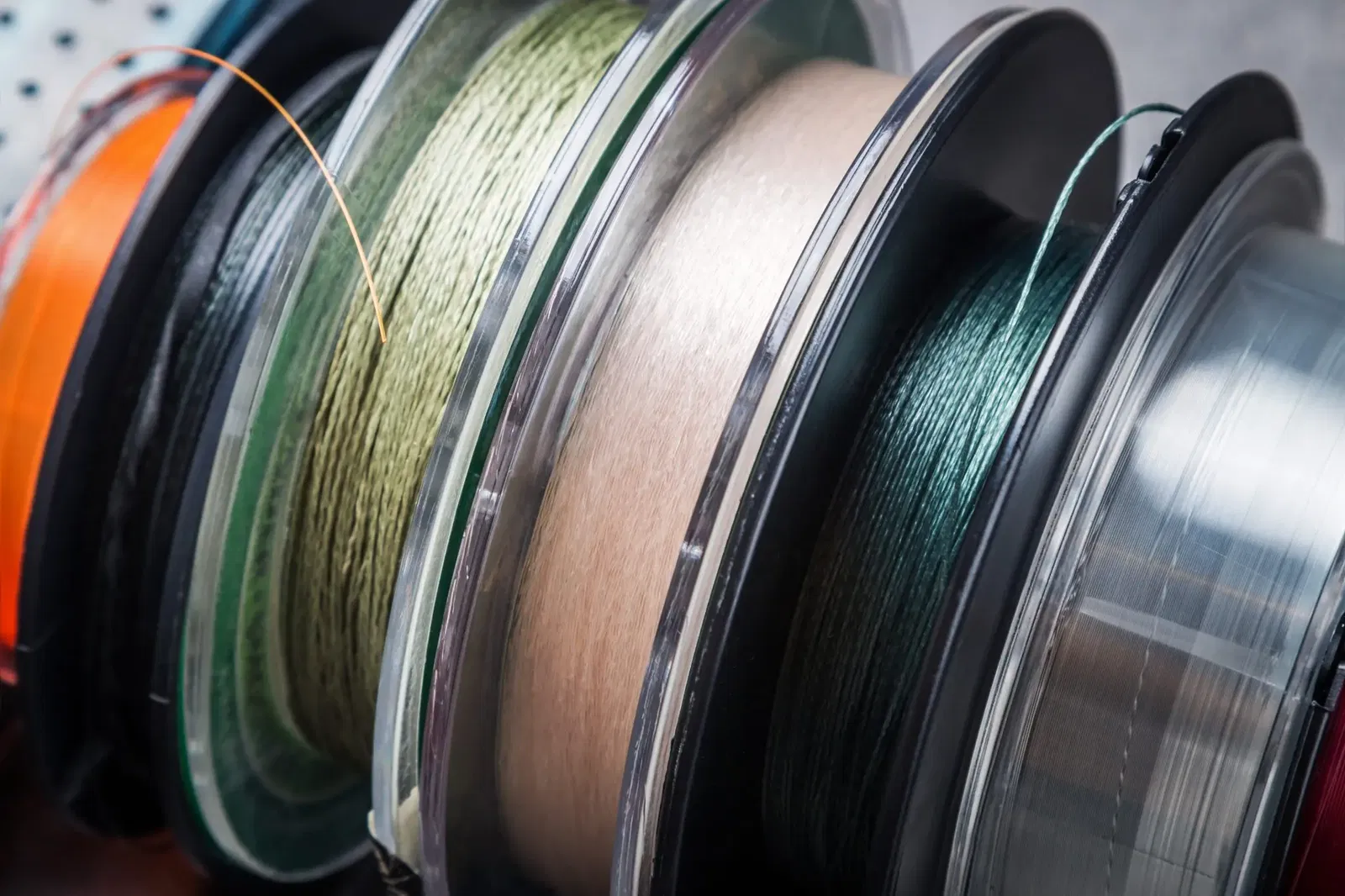
Fluorocarbon line is made from polyvinylidene difluoride (PVDF), which has a refractive index of approximately 1.42 — much closer to water’s 1.33 than nylon monofilament’s 1.53. This means fluorocarbon bends light less than mono, making it harder for fish to detect underwater. While optical analysis has challenged the claim that fluorocarbon is truly “invisible” (Thomson, 2001), the reduced visibility relative to mono is physically measurable and tactically relevant — especially in clear water where pressured bass have learned to associate visible line with danger. For a deeper comparison, see Fishing Line Types for Bass Fishing.
Fluorocarbon also sinks, which helps maintain a direct connection to bottom-contact baits. Its low stretch (compared to mono) transmits subtle bites more effectively, which is critical when the hookset window on a finesse bite may be only a second or two.
Practical guidelines:
- Drop shot: 6-8 lb fluorocarbon (main line or leader)
- Ned rig: 6-8 lb fluorocarbon
- Shaky head: 8-10 lb fluorocarbon
- Wacky rig: 8-12 lb fluorocarbon (or braid main with 8 lb fluoro leader)
Rod Selection for Finesse
A finesse rod is not just a light rod. It is designed to load on small fish, transmit subtle bites, and protect light line. Key specs: 6’10” to 7’2” length, medium-light to medium power, fast to extra-fast action, high-modulus graphite for sensitivity. The goal is a rod that lets you feel the difference between bottom composition, cover contact, and a bite — because finesse bites often feel like nothing at all.
Seasonal Finesse Patterns
Finesse weight in the equation shifts throughout the year, but it never drops to zero.
Pre-spawn (48-58°F): Shaky head and Ned rig on staging points and channel swings. Bass are moving but not aggressive.
Spawn (58-68°F): Wacky rig into beds triggers defensive bites. Drop shot hovers in the face of nesting males that will not chase.
Post-spawn (65-75°F): Shaky head and drop shot as lethargic bass transition off beds to nearby structure.
Summer (75-85°F): Drop shot dominates. Vertical presentations on offshore ledges, brush piles, and deep points. This is the season where the drop shot earns its tournament reputation.
Fall (65-55°F, declining): Finesse takes a back seat to shad-chasing reaction bites — until fronts shut down the feed. Ned rig on secondary points catches transitional fish.
Winter (below 50°F): Finesse is the primary approach. Drop shot and shaky head fished painfully slowly on deep structure. Metabolism is at its annual low.
Connecting the Variables
Finesse fishing is one approach variable in the larger equation. It carries significant weight under specific conditions — high pressure, clear water, post-frontal weather, cold temperatures, pressured populations — and less weight under others. The science is clear on why it works: pressured bass become more selective, ambush-oriented, and risk-averse, and slow, subtle presentations match those behavioral shifts better than power techniques.
But finesse does not exist in isolation. Water temperature determines metabolic rate and willingness to chase. Barometric pressure influences activity level. Water clarity determines how much visual stealth matters. Seasonal phase determines where fish are positioned and what they are eating. Wind and current affect how much a finesse bait can be felt by the bass’s lateral line. Every one of these factors changes the weight that finesse carries on a given day.
The angler who understands this — who recognizes that finesse is a tool calibrated to specific conditions, not a universal solution — makes better decisions on the water.
References
- Anderson, O. (1984). “Optimal foraging by largemouth bass in structured environments.” Ecology 65(3):851-861.
- Clark, R.D. & Rabeni, C.F. (2017). “Effect of fishing effort on catch rate and catchability of largemouth bass in small impoundments.” Fisheries Management and Ecology 24(4):299-305.
- Gardiner, J.M. & Motta, P.J. (2012). “Largemouth bass (Micropterus salmoides) switch feeding modalities in response to sensory deprivation.” Zoology 115(2):78-83.
- Howick, G.L. & O’Brien, W.J. (1983). “Piscivorous feeding behavior of largemouth bass: an experimental analysis.” Transactions of the American Fisheries Society 112:508-516.
- Jones, K.A. (2002). Knowing Bass: The Scientific Approach to Catching More Fish. Lyons Press.
- Lennox, R.J., et al. (2017). “What makes fish vulnerable to capture by hooks? A conceptual framework and a review of key determinants.” Fish and Fisheries 18(5):986-1010.
- Louison, M.J., Hage, V.M., Stein, J.A., & Suski, C.D. (2019a). “Quick learning, quick capture: largemouth bass that rapidly learn an association task are more likely to be captured by recreational anglers.” Behavioral Ecology and Sociobiology 73:25.
- Louison, M.J., Stein, J.A., Keenan, T.J., & Suski, C.D. (2019b). “Largemouth bass use prior experience, but not information from experienced conspecifics, to avoid capture by anglers.” Fisheries Management and Ecology 26(6):600-609.
- Lovén Wallerius, M., Johnsson, J.I., Cooke, S.J., & Arlinghaus, R. (2020). “Hook avoidance induced by private and social learning in common carp.” Transactions of the American Fisheries Society 149(4):498-510.
- Nyberg, D.W. (1971). “Prey capture in the largemouth bass.” American Midland Naturalist 86(1):128-144.
- Philipp, D.P., Cooke, S.J., Claussen, J.E., Koppelman, J.B., Suski, C.D., & Burkett, D.P. (2009). “Selection for vulnerability to angling in largemouth bass.” Transactions of the American Fisheries Society 138(1):189-199.
- Richard, B.A. & Wainwright, P.C. (1995). “Scaling the feeding mechanism of largemouth bass: kinematics of prey capture.” Journal of Experimental Biology 198:419-433.
- Sass, G.G. & Motta, P.J. (2002). “The effects of satiation on strike mode and prey capture kinematics in the largemouth bass, Micropterus salmoides.” Environmental Biology of Fishes 65:441-454.
- Thomson, J. (2001). “Mathematical theory of fishing line visibility.” Technical analysis applying Mie scattering theory to fluorocarbon and monofilament line visibility underwater.
- Webb, P.W. (1986). “Effect of body form and response threshold on the vulnerability of four species of teleost prey attacked by largemouth bass.” Canadian Journal of Fisheries and Aquatic Sciences 43:763-771.