Ask any tournament angler to name one lure they would fish for the rest of their lives, and the answer comes back the same more often than not: a jig. No other bass lure covers as much water, works at as many depths, or mimics as many forage types as a simple lead-head jig dressed with a silicone skirt and a soft-plastic trailer.
But here is the thing most "jig basics" articles get wrong — a jig is not one technique. It is a framework of variables. The head shape, the weight, the trailer, the retrieve speed, the line type, and the seasonal context all interact to create a presentation. Change one variable and the equation shifts. That is what makes jigs both the most versatile and most misunderstood lure in your tacklebox.
This guide breaks jig fishing into the variables that matter, explains the biology behind why bass eat jigs in the first place, and gives you a system for dialing in the right combination on any given day.
Why Bass Eat Jigs: The Biology
Before you tie on a jig, it helps to understand what makes bass strike one. Largemouth bass are primarily ambush predators — they position near structure (wood, rock, grass edges, docks) and attack prey from short distances. Their primary capture mode is ram feeding: accelerating forward to overtake prey with the mouth open (Sass & Motta, Environmental Biology of Fishes, 2002). In fact, the ram component — body velocity at the moment of capture — is the primary axis of feeding diversity across the entire centrarchid family (Longo et al., Journal of Experimental Biology, 2016). But when visibility drops — muddy water, low light, heavy cover — bass shift toward suction feeding, rapidly expanding the mouth cavity to draw prey in with negative pressure (Gardiner & Motta, Zoology, 2012; Sanford & Wainwright, Journal of Experimental Biology, 2002).
This matters for jig anglers because a jig triggers both feeding modes. On the fall, a jig mimics a crawfish or baitfish dropping through the water column — triggering the visual ram-strike instinct. On the bottom, a jig pushed through cover creates water displacement that bass detect through their lateral line, a sensory organ that runs the length of their body and is sensitive enough to detect prey movements and nearby water displacement even in zero visibility (Gardiner & Motta, Zoology, 2012; Bleckmann, Integrative Zoology, 2009). Research on catfish has demonstrated that some fish species can even track prey by following the turbulence trail left in the water column (Pohlmann et al., PNAS, 2001) — and while that specific capability has not been confirmed in bass, it underscores just how much information the lateral line provides. A jig with a bulky skirt and flapping trailer pushes water in a way that screams "easy meal" to a bass relying on vibration detection.
Bass also strike jigs for reasons that have nothing to do with hunger. Reaction strikes — instinctive responses to sudden movement, territorial intrusion, or competitive pressure — account for a significant portion of bass catches. When a jig crashes into a laydown or hops sharply off a rock, the sudden movement can provoke a strike from a bass that was not actively feeding. This is why jigs catch fish even during tough conditions when finesse baits struggle.
The Five Jig Types Every Angler Should Know
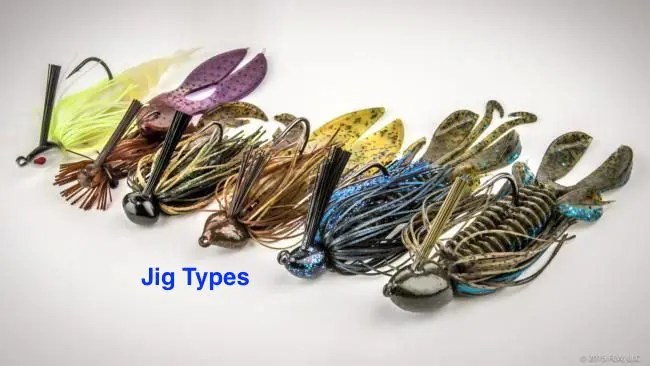
Not all jigs are interchangeable. Each head shape, hook gauge, and weed guard design is optimized for specific cover, depth, and retrieve styles. Here are the five types that cover virtually every bass fishing scenario. For a deeper dive into all eight jig categories including Ned rigs, punch jigs, and hair jigs, see our complete guide to jig types.
Casting Jig (the all-rounder). A round or arky-style head with a standard wire hook and moderate weed guard. This is the jack-of-all-trades — effective for dragging along sloping rock banks, hopping across points, skipping under docks, and working ledges. If you could only own one jig type, this is it. Typical weights: 3/8 to 1/2 oz.
Flipping Jig. Built for close-quarters combat in heavy cover. Flipping jigs feature a compact head, heavy-gauge hook, and stiff weed guard designed to punch through matted vegetation, laydowns, and dock pilings without snagging. The retrieve is vertical — pitch or flip the jig into cover, let it fall on a controlled semi-slack line, and feel for the bite. Typical weights: 3/8 to 1 oz.
Football Jig. Named for its oblong, football-shaped head that rocks side-to-side as it crawls over rocky bottom. The wide head prevents the jig from wedging into crevices, making it the go-to choice for offshore rock piles, gravel points, and rip-rap. Football jigs excel at slow-dragging presentations on the bottom. Typical weights: 1/2 to 3/4 oz.
Swim Jig. A streamlined, narrow head with a light wire hook and minimal weed guard, designed for a steady horizontal retrieve through sparse cover, grass edges, and open water. Swim jigs mimic baitfish, bluegill, or shad rather than crawfish. Pair them with a paddle-tail swimbait trailer for a natural swimming action. Typical weights: 1/4 to 1/2 oz.
Finesse Jig. A downsized, compact jig (typically 1/4 oz or lighter) with a smaller hook and lighter skirt for pressured or clear-water situations. Finesse jigs work well when bass are lethargic — post-frontal conditions, extreme cold or heat, heavily pressured fisheries. Fish them on lighter tackle (medium-power rod, 10-12 lb fluorocarbon) with subtle, short hops.
Choosing the Right Weight: Depth, Cover, and Conditions
Jig weight is not just about getting to the bottom faster. It determines fall rate, bottom feel, and how well you maintain contact in wind or current. Here is a practical framework:
| Weight | Best For | Depth Range | Conditions |
|---|---|---|---|
| 1/4 oz | Finesse, shallow flats, clear water | 1-8 ft | Calm, light cover, pressured fish |
| 3/8 oz | The most versatile weight; works almost anywhere | 5-15 ft | Moderate wind, moderate cover |
| 1/2 oz | Deeper structure, heavier cover, windy days | 10-25 ft | Wind, current, dense cover |
| 3/4 oz+ | Deep offshore, heavy current, football jig applications | 20-40 ft | Strong wind, deep rock, river current |
But weight is only half the equation. Your trailer dramatically affects fall rate. A bulky craw trailer with wide-flapping appendages creates significant water resistance — a 1/2 oz jig with a big trailer can fall as slowly as a 3/8 oz jig with a compact chunk trailer. This gives you a powerful tuning knob: if bass want a slow fall but you need the weight for casting distance or bottom contact in wind, go heavier on the head and bulkier on the trailer. If they want a fast, aggressive drop, use a streamlined trailer or downsize.
A useful starting rule: in water below roughly 60 degrees F, bass metabolism slows and they prefer a slower fall. In warmer water where bass are actively hunting, a faster fall can trigger reaction strikes. But this is one variable among many — wind, cover density, and water clarity all shift the calculation.
Trailer Matching: The Variable Most Anglers Overlook
The trailer is not an afterthought. It determines whether your jig imitates a crawfish, a baitfish, or something in between. It controls fall rate, action, and profile.
Crawfish trailers (chunk/craw style). The default for bottom-contact jigs — casting jigs, flipping jigs, football jigs. Wide, flapping appendages create water displacement and mimic a crawfish's defensive posture. There is a reason crawfish imitations are the bread-and-butter of jig fishing: stomach content studies have found that crayfish can comprise over half of a largemouth bass's diet by weight on a year-round basis (Aggus, Proc. SE Assoc. Game Fish Comm., 1973). Match the trailer color to the local crawfish: green pumpkin and brown/orange for clear water; black/blue and dark red for stained water. For more on lure color selection, see our full guide.
Swimbait trailers (paddle-tail or boot-tail). The default for swim jigs. A paddle-tail trailer adds a tight wobble that mimics a fleeing baitfish. Match size to the local forage — a 3.5-inch paddle tail for shad-sized baitfish, a 4.5-inch for larger bluegill profiles.
Compact chunk trailers. A middle ground — less action than a full craw, more compact profile. These are excellent in cold water when you want subtle movement without the bulk. They also work well when bass are keying on smaller prey items.
Color matching principle. In clear water, match the natural forage (green pumpkin, watermelon red, natural craw). In stained water, go with high-contrast silhouettes (black/blue, black/chartreuse). The reason is rooted in bass vision: bass are dichromatic with strong sensitivity to greens and reds but poor blue discrimination (Mitchem et al., Current Zoology, 2018). In turbid water, they rely more on silhouette contrast than color detail — which is why dark profiles against lighter water above are so effective.
Seasonal Strategies: One Lure, Four Approaches
A jig works year-round, but the application changes with the seasons. Here is how the variables shift.
Pre-spawn and spawn (water temperatures in the upper 50s through 60s). Bass are moving shallow and relating to hard bottom, isolated cover, and spawning flats. A 3/8 oz casting jig or flipping jig with a crawfish trailer, dragged slowly along transition banks and staging areas, is one of the most consistent pre-spawn producers. Bass are territorial and aggressive near beds — reaction strikes are common. During the spawn itself, a compact finesse jig can provoke bed-guarding males into striking.
Post-spawn through summer. As water warms into the bass's optimal activity range — which for largemouth is 80-84 degrees F (Diaz et al., Aquaculture Research, 2007) — bass scatter between shallow and deep patterns. Swim jigs shine along grass edges and shallow cover during low-light periods (dawn, dusk, overcast). Football jigs dominate offshore rock piles, points, and ledges where bass congregate around structure in deeper water. Summer is the season to fish jigs faster and cover more water.
Fall. Cooling water triggers baitfish migrations toward the backs of creeks, and bass follow. Swim jigs with swimbait trailers are dynamite for covering shallow flats and creek channels where shad are schooling. As water drops into the 60s, switch back to casting jigs and crawfish trailers fished around laydowns and isolated cover. Fall bass are feeding aggressively to build reserves — heavier jigs and faster retrieves often outperform finesse.
Winter (water below 50 degrees F). Metabolism drops and bass become lethargic. A football jig dragged painfully slowly along deep structure — main lake points, channel swings, bluff walls — with a compact, low-action trailer is one of the few reliable cold-water techniques. Expect long pauses between bites. The key variable in winter is patience: let the jig sit on the bottom for 10-15 seconds between drags. Bites will often feel like nothing more than a slight heaviness or "mushy" resistance.
Gear Setup: Rod, Reel, and Line
The right tackle makes the difference between feeling bites and missing them.
Rod. A 7'0" to 7'3" medium-heavy power, fast-action casting rod is the most versatile jig rod. The fast tip transmits bottom contact and subtle bites, while the medium-heavy backbone provides hook-setting power. For flipping heavy cover, step up to a 7'3"-7'6" heavy power rod. For finesse jigs, step down to a 7'0" medium power.
Reel. A low-profile baitcasting reel in the 6.3:1 to 7.1:1 gear ratio range. The moderate-fast retrieve lets you pick up slack quickly for hook sets without reeling the jig too fast. For swim jigs, a slightly faster ratio (7.1:1+) helps maintain a steady retrieve.
Line. This is where many anglers get it wrong. Fluorocarbon (15-20 lb test) is the standard jig line for most applications — it sinks (maintaining bottom contact), has low stretch (for solid hook sets), and is nearly invisible underwater. The exception: in heavy vegetation or matted grass, switch to braided line (40-65 lb) for its zero-stretch, cut-through-grass properties. For finesse jigs in clear water, drop to 10-12 lb fluorocarbon. For more on line choices, see our fishing line types guide.
Setting the Hook: Technique Over Speed
"Set the hook when you feel a bite" is the most common jig fishing advice, and it is incomplete. Here is the full process:
- Recognize the bite. Jig bites rarely feel like a dramatic "thump." More often, you will feel a subtle heaviness, a "tick," or notice your line moving slightly to one side. In cold water, the bite may feel like your jig simply got heavier.
- Reel down. Before setting the hook, drop your rod tip toward the water and reel in slack until your line is tight and you can feel the fish's weight. This is the step most anglers skip, and it is the reason they miss fish — you cannot drive a hook through a bass's jaw with slack line between you and the fish.
- Snap set. With the rod tip near the water and the line tight, snap the rod sharply upward to the 12 o'clock position. The motion should come from your entire upper body, not just your wrists. The goal is to drive the hook point up through the roof of the bass's mouth, where the bone is thinnest.
- Keep pressure. After the hook set, keep your rod loaded and reel steadily. A jig hook buried in the roof of the mouth rarely comes out if you maintain tension.
One important nuance: in cold water (below 50 degrees F), bass often "mouth" the jig without fully committing. Some experienced anglers recommend a brief half-second pause between feeling the bite and setting the hook, allowing the bass to close its mouth fully around the jig before you drive it home. This is a feel thing that develops with practice.
Putting It All Together: The Variable Equation
If there is one takeaway from this guide, it is this: jig fishing is a system of variables, not a single technique. The jig type, weight, trailer, color, retrieve speed, rod angle, and line type are all dials you can turn. The conditions — depth, cover type, water clarity, water temperature, wind, seasonal phase, and bass activity level — tell you which way to turn them.
No single variable dominates. A 3/8 oz black-and-blue flipping jig is a legendary combination, but it is not the answer to every question. On a calm, clear, post-frontal spring day, a 1/4 oz finesse jig on 12 lb fluorocarbon might outfish it ten to one. On a windy fall day with stained water and bass chasing shad in the shallows, a 1/2 oz swim jig with a paddle-tail trailer could be the only thing that gets bit.
The anglers who catch the most fish on jigs are the ones who read the conditions, make an educated first choice, and adjust quickly when the variables shift. That process — reading conditions, weighing variables, adapting in real time — is exactly what separates a good day on the water from a great one.
References
- Sass, G.G. & Motta, P.J. (2002). "The effects of satiation on strike mode and prey capture kinematics in the largemouth bass, Micropterus salmoides." Environmental Biology of Fishes 65:441-454.
- Gardiner, J.M. & Motta, P.J. (2012). "Largemouth bass switch feeding modalities in response to sensory deprivation." Zoology 115(2):78-83.
- Sanford, C.P.J. & Wainwright, P.C. (2002). "Use of sonomicrometry demonstrates the link between prey capture kinematics and suction pressure in largemouth bass." Journal of Experimental Biology 205:3445-3457.
- Longo, S.J. et al. (2016). "Body ram, not suction, is the primary axis of suction-feeding diversity in spiny-rayed fishes." Journal of Experimental Biology 219:119-128.
- Bleckmann, H. (2009). "Lateral line system of fish." Integrative Zoology 4:13-25.
- Pohlmann, K., Grasso, F.W., & Breithaupt, T. (2001). "Tracking wakes: The nocturnal predatory strategy of piscivorous catfish." PNAS 98(13):7371-7374.
- Aggus, L.R. (1973). "Food of angler harvested largemouth, spotted and smallmouth bass in Bull Shoals Reservoir, Arkansas." Proc. SE Assoc. Game Fish Comm. 26:519-529.
- Mitchem, L.D. et al. (2018). "Seeing red: color vision in the largemouth bass." Current Zoology 65(1):43-52.
- Diaz, F. et al. (2007). "Temperature preference and oxygen consumption of the largemouth bass." Aquaculture Research 38(13):1387-1394.
- Horning, W.B. & Pearson, R.E. (1973). "Growth temperature requirements for juvenile smallmouth bass." J. Fish. Res. Board Can. 30(8):1226-1230.
- Heidinger, R.C. (1976). "Synopsis of biological data on the largemouth bass." FAO Fisheries Synopsis No. 115.
- Wired2Fish — "How to Choose the Right Bass Jig Weight and Trailer." Link
- Tackle Warehouse — "How-To Choose the Right Jig." Link
- Mystery Tackle Box — "Jig Fishing 101: When To Use 6 Types Of Jigs." Link
- Major League Fishing — "Bass Fishing 101: Choose the Right Jig." Link
- Field & Stream — "Jig Fishing for Bass, Styles and Techniques." Link
- In-Fisherman — "Bass Senses: Hearing & Lateral Line." Link
- BassResource — "The Setup: Ideal Rod/Reel/Line Combos." Link
- Wired2Fish — "How to Set the Hook on Bass Using Jigs." Link
- SportFishingBuddy — "Jig Fishing Setup For Bass." Link