If you had to cut your tackle to five lures and fish an entire season, what makes the cut? Every tournament angler has an opinion. But the question worth asking is not just which five — it is why those five cover the widest range of conditions that bass actually encounter.
Lure choice is one variable in a larger equation. Water temperature, clarity, seasonal phase, forage base, structure, light conditions, and barometric pressure all interact to determine what bass will eat on any given day (Coutant, 1975; Cherry et al., 1975). The lures below are not magic. They are tools — each one optimized to exploit a different combination of sensory triggers that bass biology makes them vulnerable to. Understanding the science behind why these lures work will make you more dangerous with all of them.
The Science Behind Lure Selection
Before we get to the list, you need to understand how bass actually detect and decide to eat your lure. Three biological systems drive every strike.
The Lateral Line: Feeling Your Lure From a Distance
Every bass has a row of pressure-sensitive neuromasts running along each side of its body — the lateral line system. These specialized cells detect low-frequency pressure waves, broadly responsive in the range of approximately 1-200 Hz (Mogdans, 2019), with behavioral studies in the closely related sculpin showing relatively flat sensitivity from 10 to 100 Hz when measured in terms of water acceleration (Coombs & Janssen, 1990). This means bass can “feel” your lure vibrating from distances well beyond visual range, particularly in stained or turbid water where visibility drops to inches.
The lateral line does more than detect presence. Canal neuromasts and superficial neuromasts serve different functions: superficial neuromasts respond to water flow velocity, while canal neuromasts detect pressure gradients that help localize the source (Mogdans, 2019). When a bass commits to striking, the lateral line provides fine-tuned positional data in the final milliseconds before capture (Sass & Motta, 2002). This is why lures that produce distinct, consistent vibration signatures — spinnerbaits, bladed jigs, crankbaits — trigger strikes even when bass cannot see them.
Bass Vision: What They Actually See
Bass are dichromats. They have two types of cone cells: green single cones peaking at 535 nm and red twin cones peaking at 614.5 nm (Mitchem et al., 2018). They lack blue cones and UV cones entirely. In behavioral trials, bass discriminated red from achromatic backgrounds with 85% accuracy and also distinguished green reliably, but could not tell chartreuse-yellow from white or blue from black without olfactory cues (Mitchem et al., 2018).
Bass, like many teleosts, possess a tapetum lucidum — a reflective layer behind the retina that bounces light back through the photoreceptors a second time (Arnott et al., 1970). This gives them excellent low-light vision. McMahon and Holanov (1995) found that largemouth bass foraging success exceeded 95% at light levels ranging from dim daylight down to moonlight, only declining significantly at starlight levels and near zero in total darkness. This is why dawn, dusk, and overcast conditions are prime feeding windows — bass see well enough to hunt, while their prey may not see them coming.
How Bass Actually Capture Prey
Bass use two feeding modes: ram feeding (overtaking prey with the mouth open) and suction feeding (rapidly expanding the buccal cavity to create negative pressure that pulls prey in). Sass & Motta (2002) documented that bass possess both capabilities and modulate along this continuum — most strikes are a blend of both. When bass can see prey clearly, they tend toward ram feeding. When visual information is limited — turbid water, low light, or lateral-line-only detection — they shift toward suction-dominant capture (Gardiner & Motta, 2012). Lure design matters here: a lure that is still moving when the bass commits requires different strike kinematics than one sitting motionless on the bottom.
Prey Selection: Size and Profile Matter More Than Species
Hambright (1991) demonstrated that largemouth bass never ingested prey with a body depth greater than their own external mouth width, and showed the strongest preference for prey of similar body depths regardless of species identity. This is gape-limited predation — bass are not choosing between “shad” and “crawfish” conceptually. They are assessing profile relative to their own mouth size. When you select a lure, you are not trying to perfectly replicate a specific prey species. You are presenting a profile that falls within the bass’s preferred body-depth-to-gape ratio at the depth and speed where they are willing to feed.
Breck (1993) extended this to piscivorous foraging theory, noting that the optimal foraging models developed for planktivores require significant modification for bass-sized predators. Bass do calculate energy return — they are more likely to commit to a prey item that looks like an easy, appropriately sized meal — but they also make impulsive predatory strikes triggered by erratic movement, sudden pauses, or novel stimuli. This dual nature — part calculated predator, part reaction striker — is exactly why these five lure categories cover so much water.
1. Jerkbaits: Exploiting the Pause-and-Flee Response
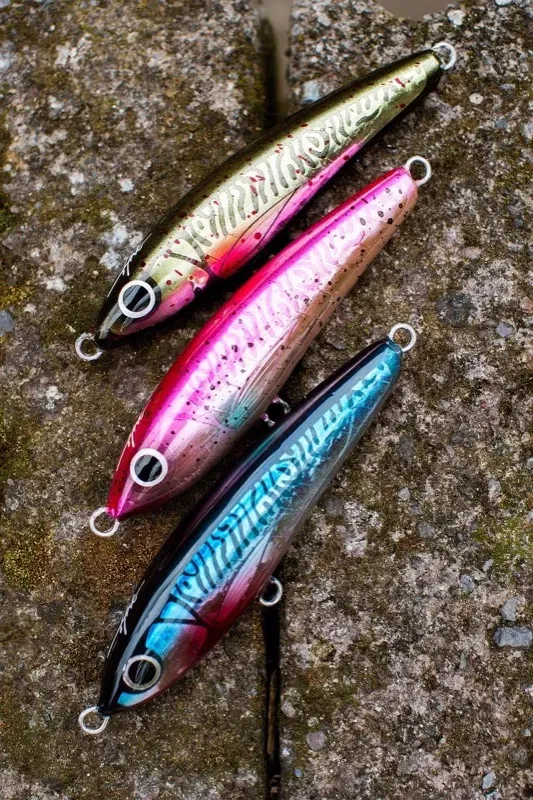
A suspending jerkbait is a hard-bodied minnow imitation that darts, pauses, and hovers in the water column. The magic is not in the darting action alone — it is in the pause.
Why it works (the science): When a jerkbait darts forward, it creates a burst of pressure disturbance detectable by the lateral line (Coombs & Janssen, 1990). When it stops, the lure hovers motionless — but the pressure signature dissipates unevenly, mimicking the irregular pulsing of an injured or disoriented baitfish. Bass that are tracking by lateral line can pinpoint the lure during the pause because the residual pressure waves decay at rates their neuromasts can resolve (Mogdans, 2019).
Visually, the pause triggers a predatory decision point. A moving target requires pursuit; a paused target offers an ambush opportunity with lower energy expenditure. McMahon and Holanov (1995) showed bass are efficient visual predators even in low light, and a stationary or slow-drifting profile within their visual range is a high-confidence target.
When it dominates: Jerkbaits excel when water temperatures sit between 45-60°F — the prespawn and late fall windows when bass metabolism is slowed enough that chasing fast-moving prey is energetically expensive, but water is warm enough that bass are still actively feeding (Coutant, 1975). In clear to moderately clear water (visibility 2+ feet), the visual component of the jerkbait is fully leveraged. As water clarity decreases, the vibration and flash become the primary triggers, and you may need to shift to lures with stronger pressure signatures.
The variable equation: Water temperature determines pause duration. In 45-50°F water, pauses of 5-10 seconds let the lure hover in the strike zone long enough for sluggish bass to commit. At 55-60°F, shorter 1-3 second pauses match the faster metabolism and more aggressive pursuit behavior. Clarity, wind, and light conditions further modify the equation. A jerkbait in stained water on an overcast day is a different presentation than the same bait in gin-clear water under bluebird skies — even if the water temperature is identical.
Cross-reference: See How Water Temperature Affects Bass Behavior for the full thermal biology behind seasonal metabolic shifts, and Lure Color Choice for Bass for the vision science behind color selection.
2. Spinnerbaits: Dual-Sensory Triggering Machines
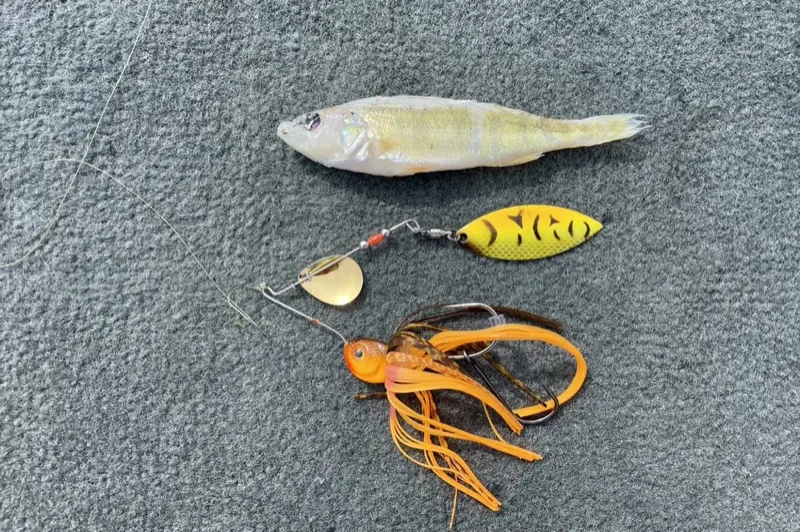
A spinnerbait combines a metal blade (or blades) that rotate on a wire arm with a weighted head and silicone skirt. It is one of the few lure designs that simultaneously stimulates both the lateral line and the visual system with high intensity.
Why it works (the science): The rotating blade creates two distinct stimuli. First, the blade displaces water in a rhythmic, pulsing pattern that produces low-frequency vibrations well within the lateral line’s detection range (Mogdans, 2019; Coombs & Janssen, 1990). Second, the polished metal surface creates intermittent flash as it rotates — a burst of reflected light followed by a dark phase as the blade turns edge-on. This strobe-like flash pattern falls within the spectral sensitivity of bass green cones at 535 nm and red twin cones at 614.5 nm, depending on blade finish (Mitchem et al., 2018; Kawamura & Kishimoto, 2002).
The combination is powerful because bass integrate information from multiple sensory systems when making predatory decisions. In turbid water, where visual range collapses, the lateral line carries the primary detection load. Shoup and Lane (2015) found that as turbidity increased, largemouth bass included a wider variety of prey types in their diets, consistent with a shift from selective, visually-guided foraging to more opportunistic prey capture. A spinnerbait in muddy water is essentially a vibrating beacon that triggers a reaction strike before the bass can visually assess whether it is actually food.
Blade type and water clarity: Colorado blades are wide and round, producing maximum vibration and slower rotation with less flash. Willow blades are narrow and elongated, producing maximum flash and minimal vibration. The selection between them is a direct application of sensory biology:
- Stained to muddy water (visibility under 1 foot): Colorado blades. Lateral line is the primary detection sense. Maximize vibration.
- Clear water (visibility 3+ feet): Willow blades. Visual system is the primary detection sense. Maximize flash, minimize the “unnatural” vibration signature.
- Moderate clarity (1-3 feet): Tandem blades (one Colorado, one willow) hedge the equation by stimulating both systems moderately.
The variable equation: Water clarity tells you which sensory channel to emphasize. Water temperature tells you how fast to retrieve (slower in cold water to match reduced pursuit speed; faster in warm water to trigger reaction strikes from active fish). Wind creates surface chop that breaks up light penetration and adds ambient noise to the water — both of which favor spinnerbaits because the blade’s vibration stands out against the background.
Cross-reference: See Spinnerbaits for Bass Fishing for a deeper dive into blade configurations, skirt colors, and retrieve techniques.
3. Soft Plastic Stick Baits: The Prey Profile Optimizer
A soft plastic stick bait (the Senko-style is the archetype) is a simple cylindrical worm with a dense, salt-impregnated body that sinks slowly with a subtle shimmy. No built-in action. No rattles. No blades. And yet it catches bass year-round, in every water clarity, at every depth. The science explains why.
Why it works (the science): The slow fall of a dense stick bait creates a gentle, low-frequency pressure disturbance as it displaces water on descent. This is within the lateral line detection range but at much lower amplitude than a spinnerbait or crankbait — closer to the signature of a dying or stunned baitfish settling through the water column.
The profile matters enormously. Hambright (1991) showed that bass select prey by body depth relative to mouth gape, not by species. A 5-inch stick bait presents a slender, elongated profile that falls within the preferred body-depth-to-gape ratio for a wide range of bass sizes — from 1-pound juveniles to 8-pound adults. This is gape-optimized forage mimicry, even though the lure does not closely resemble any specific prey species.
Color selection for stick baits maps directly to bass vision physiology. Green pumpkin falls within the 535 nm green cone sensitivity range. Watermelon red flake adds contrast from the 614.5 nm red twin cone pathway. In low-light or deeper presentations, darker colors (black/blue, junebug) create silhouette contrast that bass detect even when color perception fades with depth — red wavelengths are absorbed within the first 5-20 feet depending on water clarity, but contrast profiles remain visible far deeper (Kirk, 1994; Mitchem et al., 2018).
Rigging versatility and the variable equation:
- Wacky rig (hook through the middle): Maximizes the subtle shimmy on the fall. Best in clear, calm water where bass are visually feeding and a finesse presentation matches their mood.
- Texas rig (hook point buried, bullet weight): Adds weight for faster descent and weedless presentation. Best around cover (wood, vegetation) in moderate to stained water where bass are ambush feeding.
- Weightless Texas rig: The slowest fall rate, maximizing time in the strike zone. Deadly in shallow water (under 6 feet) when bass are positioned on flats or secondary points during prespawn and postspawn.
The stick bait covers conditions that the vibrating lures cannot. When a cold front shuts fish down — high barometric pressure, bluebird skies, clear water — bass often become negative and will not chase moving lures. A slow-sinking stick bait presented on or near the bottom puts food in their face without requiring an aggressive pursuit. Water temperature, pressure trend, and bass mood all factor into whether the stick bait is your primary or your bail-out — but it is always in the rotation.
Cross-reference: See Lure Color Choice for Bass for the full dichromatic vision science behind color selection, and Mastering Fall Bass Fishing for seasonal applications.
4. Bladed Jigs (Chatterbaits): The Erratic Vibration Wildcard
A bladed jig combines a flat hexagonal blade attached to a jig head via a line tie, creating a violent wobbling vibration as it moves through water. It occupies a unique niche in the lure spectrum — more vibration than a spinnerbait, more erratic action than a crankbait, and better weed-penetration than either.
Why it works (the science): The bladed jig’s vibration signature is fundamentally different from other vibrating lures. Where a spinnerbait’s blade produces a smooth, rhythmic rotation pattern, the bladed jig’s flat blade oscillates chaotically — deflecting left and right in an unpredictable “hunting” pattern. This erratic movement creates an irregular pressure wave that does not match any steady-state stimulus the bass’s lateral line has adapted to filter out.
This matters because of sensory habituation. Bass that experience consistent vibration patterns (boat motors, steady-retrieve spinnerbaits, even wave action) can neurologically filter those signals as background noise. An erratic, unpredictable vibration pattern cuts through habituation because the lateral line neuromasts continue to fire in response to novel or changing stimuli (Mogdans, 2019). The bladed jig is essentially an anti-habituation tool.
The hunting action also triggers reaction strikes through a different mechanism than steady-retrieve lures. When the blade kicks the jig head sideways, the lure momentarily changes direction and speed — mimicking the escape burst of a panicked baitfish. Bass that are not actively feeding may still strike reflexively at a target that appears to be fleeing, because the evolutionary cost of missing an easy meal is higher than the cost of striking at something that turns out to be inedible.
When it excels: Bladed jigs are most effective in moderate water clarity (1-4 feet visibility) at water temperatures from 55-75°F — the prespawn through early summer window when bass are actively moving and willing to chase. The combination of vibration, erratic action, and a skirt/trailer profile that matches local forage makes it a search bait that can cover water quickly while triggering both lateral-line and visual strikes.
In submerged vegetation (hydrilla, milfoil, coontail), the bladed jig has a practical advantage: the blade deflects grass stems rather than fouling on them. This means you can fish a vibrating lure through cover that would foul a spinnerbait’s exposed blades or a crankbait’s treble hooks.
The variable equation: Water clarity determines whether the bladed jig outperforms a spinnerbait (stained water favors the bladed jig’s stronger vibration) or a jerkbait (clear water may favor the jerkbait’s subtlety). Temperature determines retrieve speed. Vegetation density determines whether the bladed jig’s weed-clearing blade gives it a practical advantage over other options. No single variable makes the call — the equation does.
5. Jigs: The Bottom-Dwelling Prey Specialist
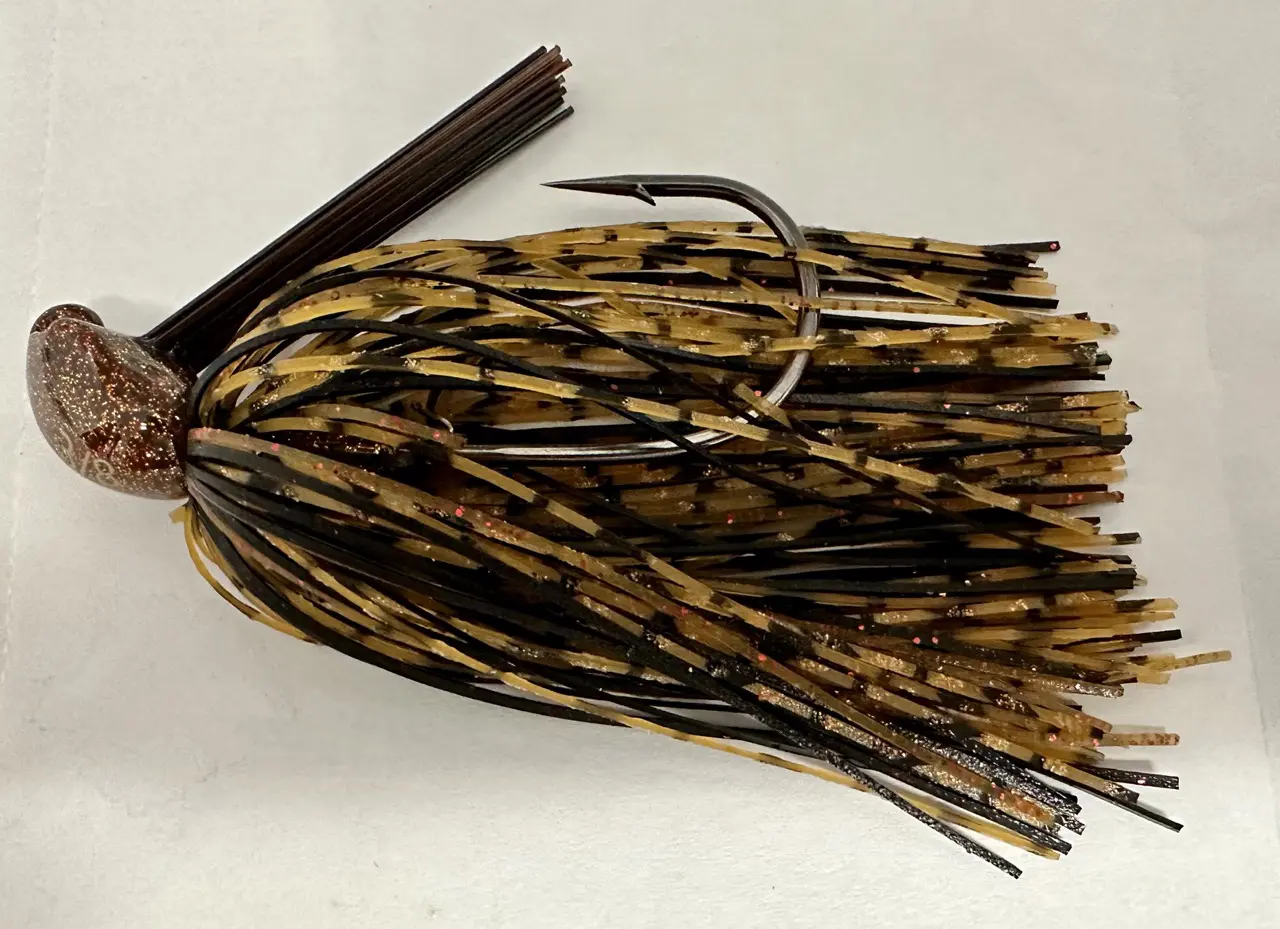
A bass jig is a weighted hook with a silicone or rubber skirt and a soft plastic trailer, fished primarily on or near the bottom. It is the most versatile single lure in bass fishing, and the science behind its effectiveness starts with what bass eat when they are feeding on the substrate.
Why it works (the science): Crawfish are among the highest-preference prey items for largemouth bass in systems where they are available. Bass actively select crawfish over other available forage of similar size, likely because crawfish offer a favorable energy-to-handling-time ratio — they are protein-dense, relatively slow-moving, and predictable in their escape behavior (backward tail-flipping).
A jig with a craw-style trailer mimics the crawfish profile: a compact, bottom-hugging silhouette with appendages that create subtle water displacement as they flutter. When the jig is hopped along the bottom, the brief lift-and-fall cycle mimics a crawfish’s defensive posture (claws raised) followed by a settling return to the substrate. The lateral line detects the pressure change from each hop at close range, and the visual system picks up the contrast of the dark, compact profile against the lighter bottom substrate.
Hambright (1991) showed that bass select prey by body depth, and a jig’s profile is compact and deep-bodied — the crawfish shape falls squarely within the preferred prey-depth range for adult bass. By adjusting trailer style, you shift the profile: a craw trailer mimics crawfish, while a grub or swimbait trailer creates a more elongated baitfish profile. This makes the jig a platform for matching whatever forage base the lake system supports.
Temperature and seasonal application: Jigs produce across the full temperature spectrum, but the mechanism changes:
- Cold water (40-55°F): Bass metabolism is low. A jig dragged slowly along the bottom puts a compact, high-calorie prey profile directly in the strike zone of lethargic fish holding on deep structure. The slow presentation matches the reduced pursuit speed that cold water imposes on bass physiology (Coutant, 1975). Pauses of 10-30 seconds between hops let bottom-hugging bass assess the target without chasing.
- Moderate water (55-70°F): Prespawn and postspawn bass are often positioned on hard bottom (rock, gravel, clay) near spawning flats. A jig pitched to specific targets — laydowns, dock pilings, rock transitions — matches the ambush-feeding mode of bass staging near structure.
- Warm water (70-85°F): Bass at their physiological optimum (Diaz et al., 2007 confirmed 80-84°F as the final thermal preferendum for largemouth) are actively feeding. Swim jigs and football jigs fished faster match the increased metabolic demand and aggressive pursuit behavior.
The variable equation: Jig weight, trailer profile, color, and presentation speed all adjust to the equation. Water depth, bottom composition, current, clarity, and temperature each modify the selection. A 3/8-oz black/blue jig crawled over deep gravel in 50°F water is solving a completely different equation than a 1/2-oz green pumpkin swim jig burned over hydrilla flats in 78°F water. Same lure category. Different variables. Different solutions.
Cross-reference: See Basics of Jig Fishing for detailed technique breakdowns, and Water Temperature and Bass for the thermal biology behind seasonal jig applications.
Putting the Equation Together
These five lure categories — jerkbaits, spinnerbaits, soft plastic stick baits, bladed jigs, and jigs — are not the five “best” lures. There is no such thing. They are five tools that, together, cover the widest range of conditions a bass angler will face across a full season:
| Condition | Primary Lure | Why |
|---|---|---|
| Cold + clear | Jerkbait (long pause) | Visual trigger, minimal energy required for strike |
| Cold + stained | Jig (slow drag) | Bottom presentation, lateral line detection at close range |
| Moderate + clear | Soft plastic stick bait | Subtle profile, gape-optimized, finesse presentation |
| Moderate + stained | Bladed jig | Erratic vibration cuts through reduced visibility |
| Warm + any clarity | Spinnerbait | Dual sensory trigger, covers water fast, matches aggressive pursuit |
| Post-frontal / negative | Soft plastic stick bait | Slow fall, minimal movement, non-threatening profile |
| Heavy vegetation | Bladed jig or jig | Weed-clearing blade or weedless bottom presentation |
But this table is a simplification. On any given day, temperature, clarity, wind, pressure trend, forage activity, light angle, and seasonal phase all interact. A falling barometer in moderate water with shad busting on the surface might call for a spinnerbait ripped fast through the top 3 feet. The same lake 24 hours later under a post-frontal high might demand a weightless stick bait dead-sticked on a secondary point. The lure is one variable. The equation is everything.
References
- Arnott, H.J., Maciolek, N.J., & Nicol, J.A.C. (1970). “Retinal tapetum lucidum: a novel reflecting system in the eye of teleosts.” Science 169(3944):478-480.
- Breck, J.E. (1993). “Foraging theory and piscivorous fish: are forage fish just big zooplankton?” Transactions of the American Fisheries Society 122:902-911.
- Cherry, D.S., Dickson, K.L., & Cairns, J. (1975). “Temperatures selected and avoided by fish at various acclimation temperatures.” Journal of the Fisheries Research Board of Canada 32(4):485-491.
- Coombs, S. & Janssen, J. (1990). “Behavioral and neurophysiological assessment of lateral line sensitivity in the mottled sculpin, Cottus bairdi.” Journal of Comparative Physiology A 167:557-567.
- Coutant, C.C. (1975). “Responses of bass to natural and artificial temperature regimes.” In Black Bass Biology and Management, Sport Fishing Institute, Washington, DC. pp. 272-285.
- Diaz, F., et al. (2007). “Temperature preference and oxygen consumption of the largemouth bass Micropterus salmoides acclimated to different temperatures.” Aquaculture Research 38(13):1387-1394.
- Gardiner, J.M. & Motta, P.J. (2012). “Largemouth bass (Micropterus salmoides) switch feeding modalities in response to sensory deprivation.” Zoology 115(2):78-83.
- Hambright, K.D. (1991). “Experimental analysis of prey selection by largemouth bass: role of predator mouth width and prey body depth.” Transactions of the American Fisheries Society 120(4):500-508.
- Kawamura, G. & Kishimoto, T. (2002). “Color vision, accommodation and visual acuity in the largemouth bass.” Fisheries Science 68:1041-1046.
- Kirk, J.T.O. (1994). Light and Photosynthesis in Aquatic Ecosystems. 2nd ed. Cambridge University Press.
- McMahon, T.E. & Holanov, S.H. (1995). “Foraging success of largemouth bass at different light intensities: implications for time and depth of feeding.” Journal of Fish Biology 46:759-767.
- Mitchem, L.D., Stanis, S., Zhou, M., Loew, E., Epifanio, J.M., & Fuller, R.C. (2018). “Seeing red: color vision in the largemouth bass.” Current Zoology 65(1):43-52.
- Mogdans, J. (2019). “Sensory ecology of the fish lateral-line system: morphological and physiological adaptations for the perception of hydrodynamic stimuli.” Journal of Fish Biology 95(1):53-72.
- Sass, G.G. & Motta, P.J. (2002). “The effects of satiation on strike mode and prey capture kinematics in the largemouth bass, Micropterus salmoides.” Environmental Biology of Fishes 65:441-454.
- Shoup, D.E. & Lane, W.D. (2015). “Effects of turbidity on prey selection and foraging return of adult largemouth bass in reservoirs.” North American Journal of Fisheries Management 35(5):913-924.
- Heidinger, R.C. (1976). “Synopsis of biological data on the largemouth bass Micropterus salmoides.” FAO Fisheries Synopsis No. 115.